

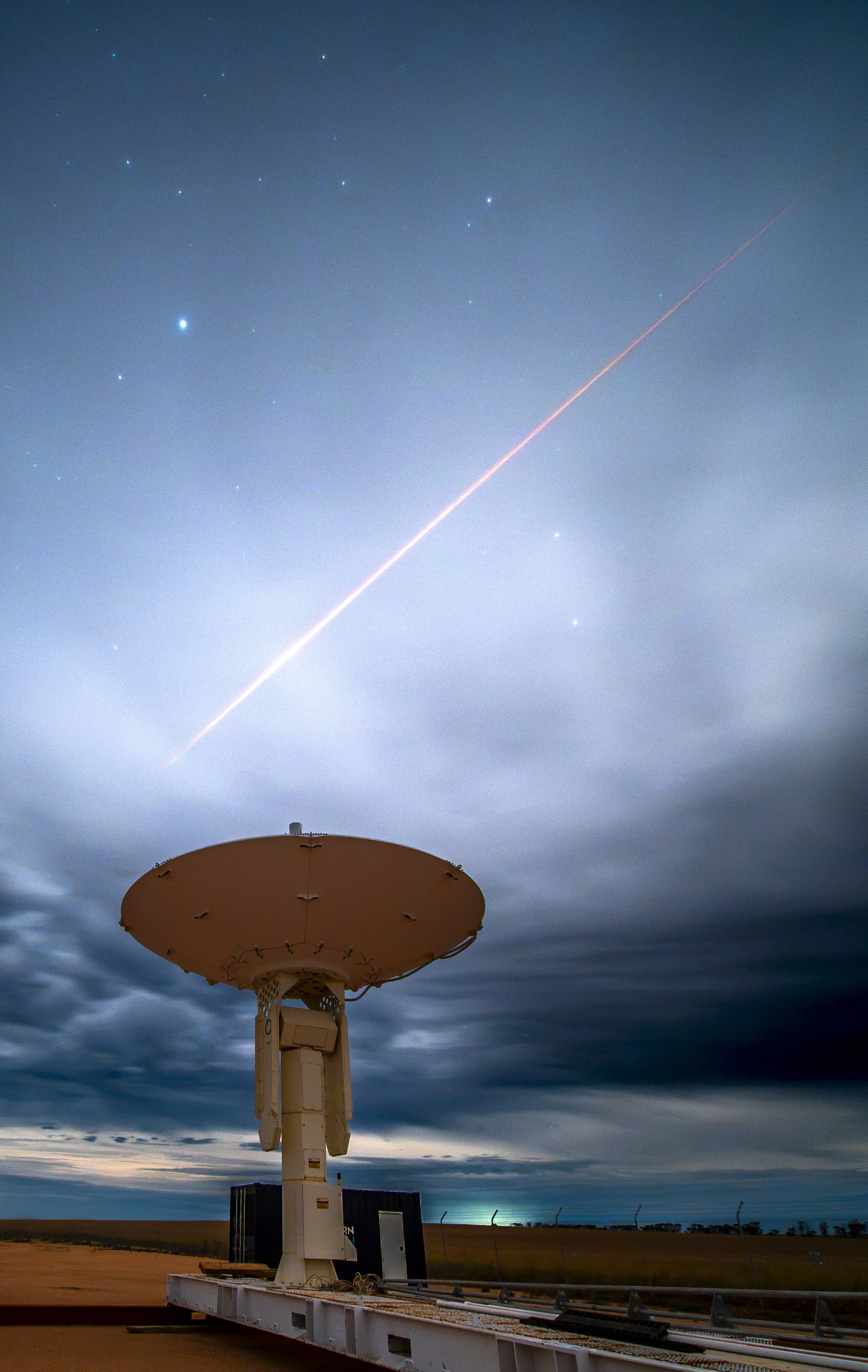
The W-9 capsule re-entering at the Koonibba Test Range
The Koonibba Test Range has welcomed its second orbital re-entry in just 12 days, as Southern Launch leads the coordination of one of the busiest periods of re-entry activity from space seen anywhere in the world.
On 18 November at 12:06am ACDT, Varda Space Industries’ W-9 capsule returned safely to Earth at the Koonibba Test Range. This follows the re-entry of the W-8 capsule on 6 November.
The W-7 mission is also scheduled to re-enter at the Koonibba Test Range in the coming weeks, bringing three spacecraft back to Earth by the Southern Launch and Varda Space Industries teams in little more than a month.
Southern Launch CEO Lloyd Damp said the pace of activity demonstrates the capability established by Southern Launch.
“It has been an incredibly busy period at the Koonibba Test Range. Just 12 days ago we were here bringing W-8 home and now we have safely completed the return of W-9.
“Bringing multiple spacecraft back from orbit within weeks of each other is something that simply isn’t happening anywhere else. It takes an enormous amount of work across our team, Varda, government, regulators and the community to make each mission happen safely.”
For each mission, Southern Launch is responsible for the end-to-end re-entry operation, coordinating regulatory approvals, range safety, airspace management, tracking, observation and recovery of the spacecraft.
Recovery operations are undertaken in close consultation with Varda’s payload specialists and cultural monitors appointed by the Far West Coast Aboriginal Corporation and Koonibba Community Aboriginal Corporation.
The current series of missions is demonstrating the different opportunities made possible by regular access to re-entry from space.
W-9 carried technology from government and industry partners to collect data through real hypersonic flight conditions. Its internal payload was a navigation system designed to collect data during hypersonic flight, while its exterior hosted advanced heatshield materials.
Varda Space Industries VP of Autonomous Systems Wendy Shimata said the missions demonstrate greater flexibility in how spacecraft can be launched and returned.
“Launching two spacecraft together and bringing them home on different days proves that Varda is first in class when it comes to flexibility in mission sets and meeting the needs of our customers.
“Every successful return proves that regular, reliable access to orbit and back is increasingly normal.”
Varda is demonstrating how manufacturing in space can support new research and technology with potential benefits on Earth. The upcoming W-7 mission will study how a promising new class of cancer medicine known as PROTACs crystallises in microgravity, with the research seeking to overcome formulation challenges and potentially make these medicines more effective for patients.
The W-7 mission will also further demonstrate the versatility of the Koonibba Test Range. While W-8 and W-9 returned from a polar orbit, W-7 will approach the range from an inclined orbit. This will require Southern Launch to operate a different re-entry corridor within the same concentrated period of activity.
The concentrated period of activity at the Koonibba Test Range is providing a glimpse of what the future of space operations will look like. Regular access to re-entry with Southern Launch is supporting new opportunities in in-space manufacturing, research and hypersonic technology development.
Koonibba Community Aboriginal Corporation CEO Corey McLennan said the missions were a source of pride for the community.
“We’re really proud to see our community leading the way globally. What is happening here at Koonibba is pretty unique and it’s exciting to see our community playing such an important role.
“Koonibba is a small community, but we’re showing that we can be part of something happening on the world stage.”